By Mike Banic
Rich King’s exploration of solo sailing reveals a history filled with courage, curiosity, fear, and an enduring fascination with the sea.
Why would anyone choose to sail alone across an ocean?
It’s a question Rich King has thought about deeply—not only as a sailor who crossed the Atlantic alone in a 28-foot Pearson Triton, but as a writer and marine environmental historian who has spent years researching the people who have made the same remarkable choice.
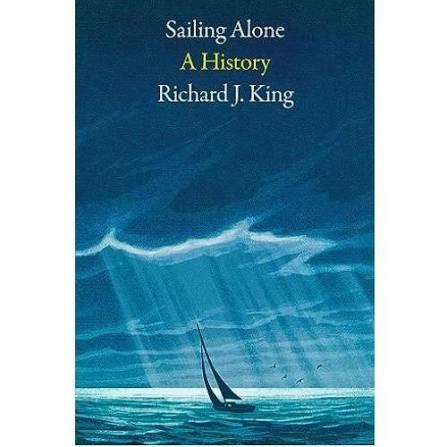
In his recent presentation to the Pelagic Sailing Club, King shared the stories behind his book Sailing Alone, taking members on a fascinating journey through the history of solo ocean sailing. His presentation was far more than a collection of sailing adventures. At its heart were two deceptively simple questions: Why do people go, and what do they see?
King's own voyage provides an important starting point.
In 2007, he sailed his Pearson Triton – Fox – from Portsmouth, New Hampshire, across the Atlantic to Portugal. The passage took five weeks. By the time he arrived, his engine was dead, his navigation resources were limited, and he was physically and emotionally exhausted.
More than 15 years later, King still occasionally finds himself transported back to that voyage by the sound of wind.
A particular tone or intensity of wind can bring back the fear he experienced during those North Atlantic gales—the mental calculations, the questions about what might break next, and the realization that he was completely alone.
That experience became part of the inspiration for *Sailing Alone*, but King is quick to point out that his book is not a manual for solo sailing or a collection of sailing records. Instead, it explores the motivations, observations, and experiences of people who have chosen to venture onto the open ocean by themselves.
And those motivations are remarkably varied.
Some sailors were escaping something. Others were running toward something. Some sought fame, money, adventure, or competition. Others simply wanted to get away.
King introduced Pelagians to an extraordinary cast of characters, including Anne Davidson, who survived the drowning of her husband and, remarkably, returned to the sea less than three years later to sail alone across the Atlantic. He discussed Joshua Slocum, the first person known to sail alone around the world, and Bernard Moitessier, who famously abandoned a likely victory in a round-the-world race because he decided he would rather keep sailing.
Then there was Teddy Seymour, the first African American known to sail around the world, and Florentino Das, a Filipino sailor who crossed the Pacific in the 1950s. King also shared stories of Sharon Sites Adams, who crossed the North Pacific with remarkably little sailing experience, and Japanese sailor Kenichi Horie, who has completed extraordinary voyages in tiny boats well into his later years.
Their stories aren't simply tales of seamanship. They are stories about identity, solitude, perseverance, risk, and the human desire to experience something beyond the ordinary.
King was equally fascinated by what these sailors observed.
A sailor alone on a small boat moves slowly enough to notice things that might otherwise go unseen. Over decades, solo sailors have recorded encounters with seabirds, whales, sharks, turtles, dolphins, flying squid, coral reefs, and bioluminescent seas. Their observations provide unusual glimpses into a changing ocean and have helped shape our cultural understanding of the marine environment.
One of King's favorite examples is Bernard Moitessier, who developed such a relationship with the shearwaters following his boat that he could eventually feed them from his hand. In another remarkable episode, dolphins appeared to repeatedly turn away from Moitessier's bow. He realized his self-steering gear had put him on a dangerous course toward shore—and the dolphins seemed to be showing him the way out.
King's research also reveals how dramatically technology has transformed solo sailing. Compare Joshua Slocum's 312-day circumnavigation in 1969 with François Gabart's astonishing 42-day solo circumnavigation, averaging roughly 27 knots. GPS, communications, weather routing, modern sails and hulls, and advances in boat design have fundamentally changed what is possible.
Yet one thing has remained remarkably consistent: the desire to tell the story.
From Slocum's books and lectures to today's blogs, videos, and social media, solo sailors have long wanted to share what happened out there. For King, those narratives are not merely records of voyages. They are works of art—and windows into how we understand ourselves and our relationship with the sea.
For Pelagic sailors, that makes King's presentation especially relevant. You don't have to be preparing for a solo ocean crossing to recognize something familiar in these stories. Anyone who has spent time alone aboard a boat knows that sailing changes when there is no one else to share the watch, the decision, the uncertainty, or the extraordinary moment with.
So, why do people go? And what do they see?
Rich King doesn't offer simple answers. Instead, he gives us a fascinating collection of stories and invites us to consider the questions for ourselves.
If you missed the presentation—or simply want to experience it again—watch the replay. You'll meet sailors you may never have heard of, hear stories that are difficult to forget, and perhaps see your own time on the water in a slightly different way.
And you may find yourself asking a very Pelagic question: What would it be like to sail alone?